Egypt’s Central Bank and Banking Sector Law No. 194 of 2020, commonly referred to simply as Law 194 of 2020, replaced the previous 2003 banking law and sets out a broad framework covering the Central Bank’s powers, banking activities, governance, supervision, confidentiality, and consumer protection. Compliance teams often assume this law is the single source of a bank’s whistleblowing obligation. The obligation is real, and it applies regardless, it just doesn’t come from one standalone article in Law 194 itself. Instead, it’s built from a combination of sources working together.
That distinction matters. To understand where banks’ whistleblowing arrangements come from, it is necessary to look at Law 194 alongside the Central Bank of Egypt’s governance and internal control instructions and the policies adopted by individual banks.
What Law 194 Actually Covers
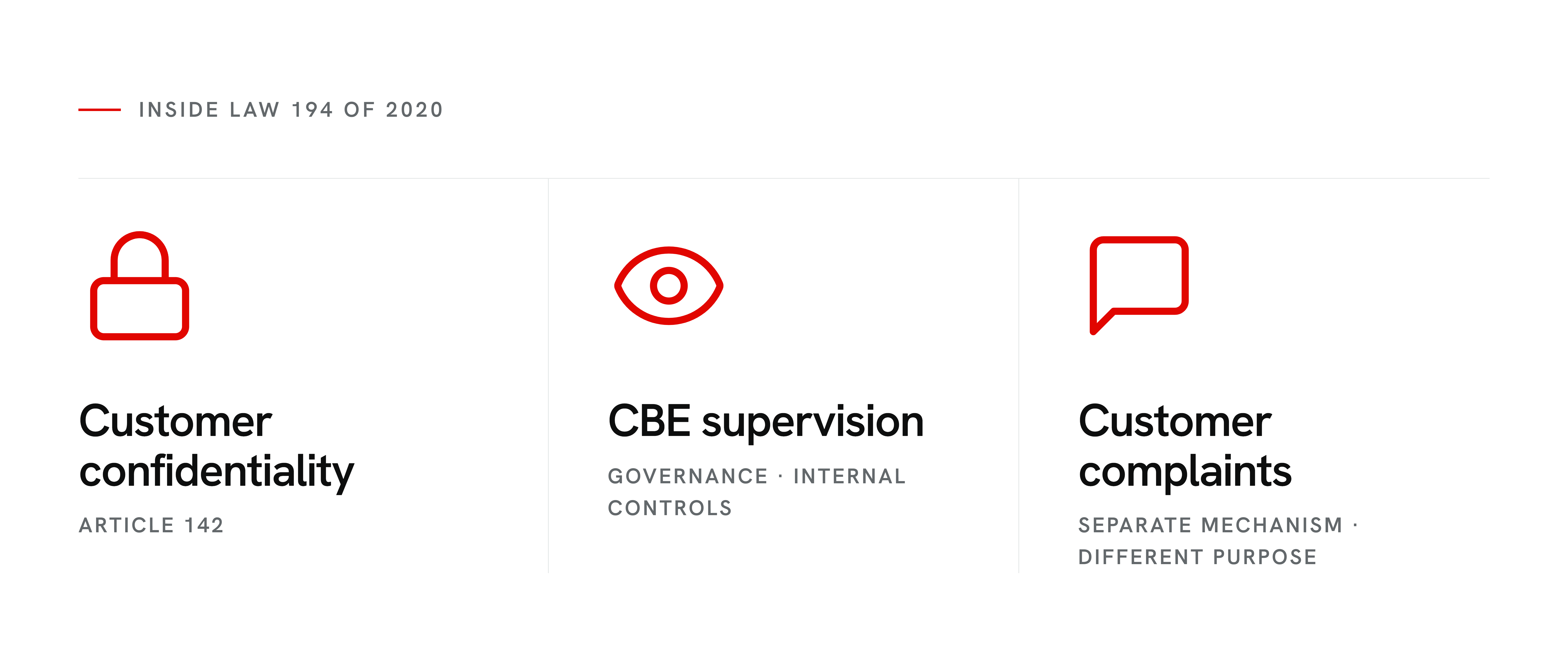
Law 194 contains important provisions that affect how banks manage information, governance, and internal controls.
Article 142, for example, addresses the confidentiality of customer information. It prohibits anyone who obtains information about customers, their accounts, deposits, or safes through their profession from disclosing that information or enabling others to access it except in cases permitted by law. The obligation continues even after the person leaves their employment.
The law also gives the CBE extensive supervisory and regulatory responsibilities over banks. The CBE’s supervisory framework includes assessing banks’ governance systems and internal control environments and ensuring compliance with applicable laws, regulations, and regulatory instructions.
Law 194 also provides for mechanisms dealing with customer complaints and consumer protection. These should not be confused with employee whistleblowing, a customer complaint mechanism addresses complaints and disputes between banking service providers and their customers, while a whistleblowing mechanism is used to raise concerns about misconduct or other issues within the organization.
Where the Whistleblowing Framework Comes From
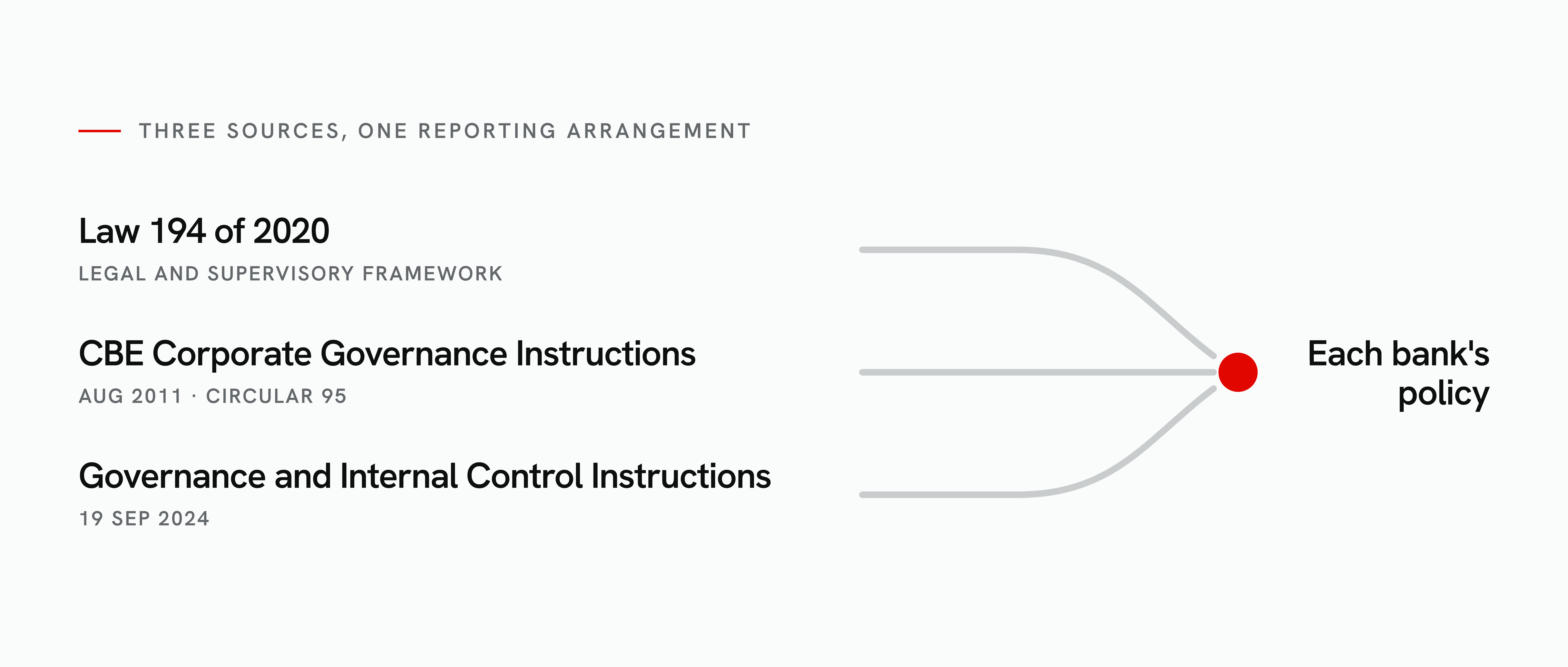
There is no single article in Law 194 that sets out a complete whistleblowing regime for Egyptian banks. Instead, banks operate within the wider governance and internal control framework established by the CBE and develop their own policies and reporting arrangements within that framework.
The CBE issued Corporate Governance Instructions for banks in 2011, and banks including CIB reference updated Governance and Internal Control Instructions dated September 2024 as part of their current compliance framework.
Published bank documents show how these requirements and broader governance standards are reflected in practice. Commercial International Bank’s whistleblowing policy states that it was developed in compliance with applicable regulatory requirements, including CBE Law No. 194 of 2020 and the CBE Corporate Governance Instructions in Circular No. 95 dated 23 August 2011.
More recent CIB materials refer to the September 2024 CBE Governance and Internal Control Instructions alongside Law 194 as part of the regulatory framework for the bank’s policies. CIB’s 2024 corporate governance report also describes its whistleblowing programme, including secure reporting channels and reporting of cases and outcomes to the Board Audit Committee.
Other banks publish similar governance arrangements. Housing and Development Bank’s own governance disclosures cite Law 194/2020 alongside the CBE’s Corporate Governance Instructions and Internal Control Regulations as the basis for its governance framework. Emirates NBD Group states that its whistleblowing policy covers suspected fraud, waste and abuse, corruption, breaches of its Code of Conduct and Ethics policies, and other criminal acts involving colleagues or management, a policy that extends across its operations, including Emirates NBD Egypt.
What This Means for Banks
For an Egyptian bank, the regulatory picture is therefore broader than a single whistleblowing provision.
Central Bank of Egypt Law 194 establishes the legal and supervisory framework for the banking sector, including important requirements around confidentiality and the CBE’s oversight of governance and internal controls. CBE governance and internal control instructions provide further regulatory requirements, while each bank’s own policies determine how reporting, investigation, escalation, and protection are handled in practice.
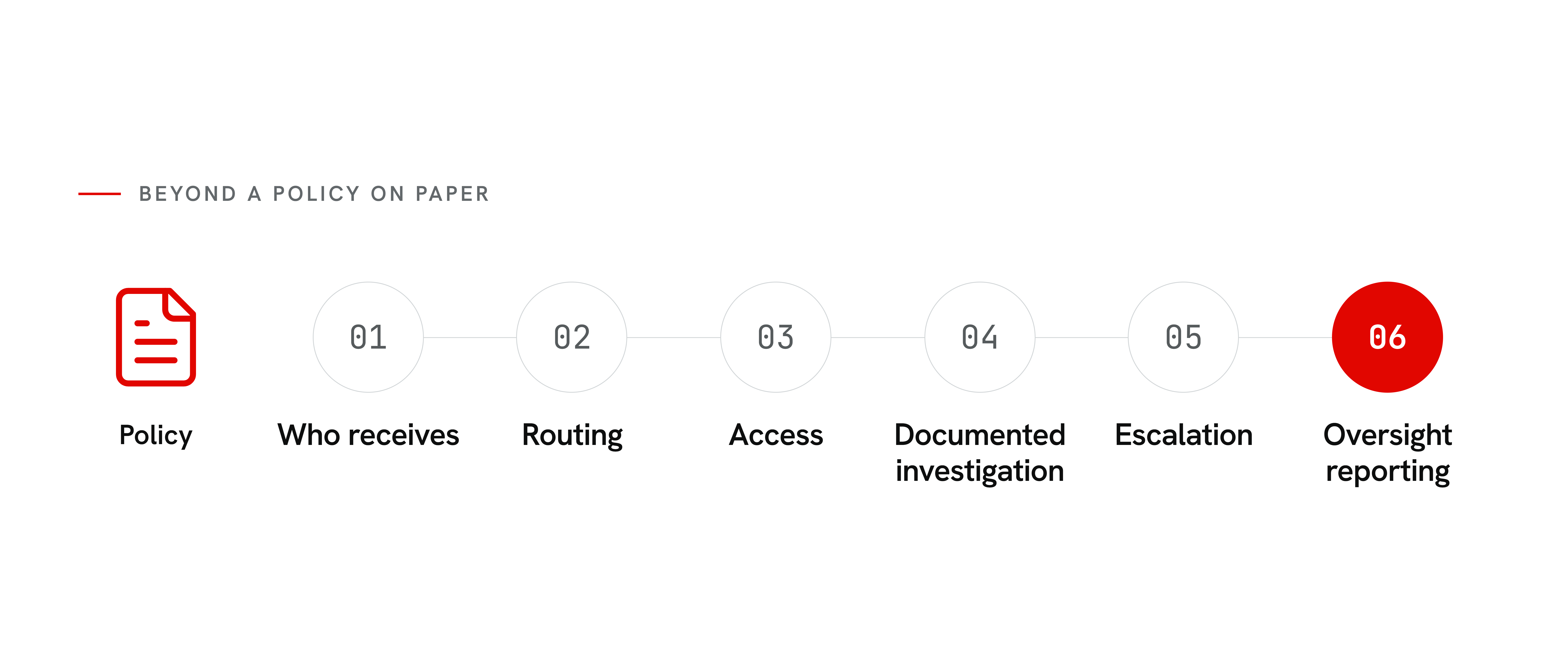
That means a bank reviewing its whistleblowing arrangements needs to look beyond whether it has a policy on paper. It also needs to consider how that policy works in practice, who receives reports, how they are routed, who can access them, how investigations are documented, and how cases are escalated and reported to the appropriate oversight functions.
What Counts as Reportable Conduct?
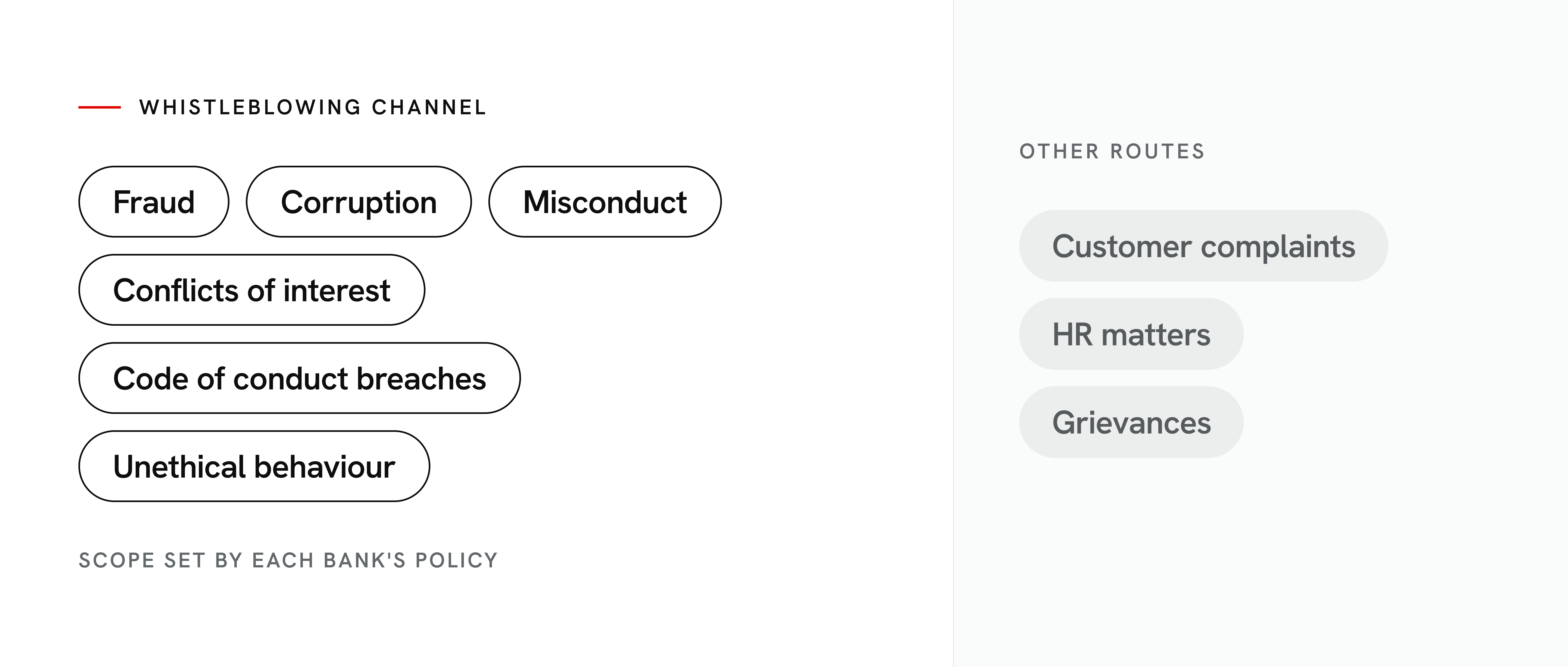
Law 194 does not provide one statutory list of matters that must be reported through a bank’s whistleblowing channel. The scope is instead defined through the bank’s own policies and related compliance requirements.
Published policies from Egyptian banks show that whistleblowing arrangements can cover matters such as suspected fraud, corruption, misconduct, conflicts of interest, breaches of internal policies or codes of conduct, and other unlawful or unethical behaviour.
For example, Emirates NBD Group states that its whistleblowing policy covers suspected fraud, waste and abuse, corruption, breaches of its Code of Conduct and Ethics policies, and other criminal acts involving colleagues or management.
CIB describes its whistleblowing programme as a channel for employees to report unethical behaviour or misconduct and provides several reporting channels, including an online portal, dedicated email, and hotline.
This is also why the boundary between whistleblowing and other internal reporting processes matters. A bank may have separate channels for customer complaints, HR matters, grievances, or other employee issues. The correct route depends on the nature of the concern and the bank’s own policies.
How iVoiceUp Fits
For banks , having the right policy is only one part of the process. Reports also need to be received, assigned, investigated, documented, and followed through.
This is where iVoiceUp can support the operational side of a bank’s reporting process through a whistleblowing platform .
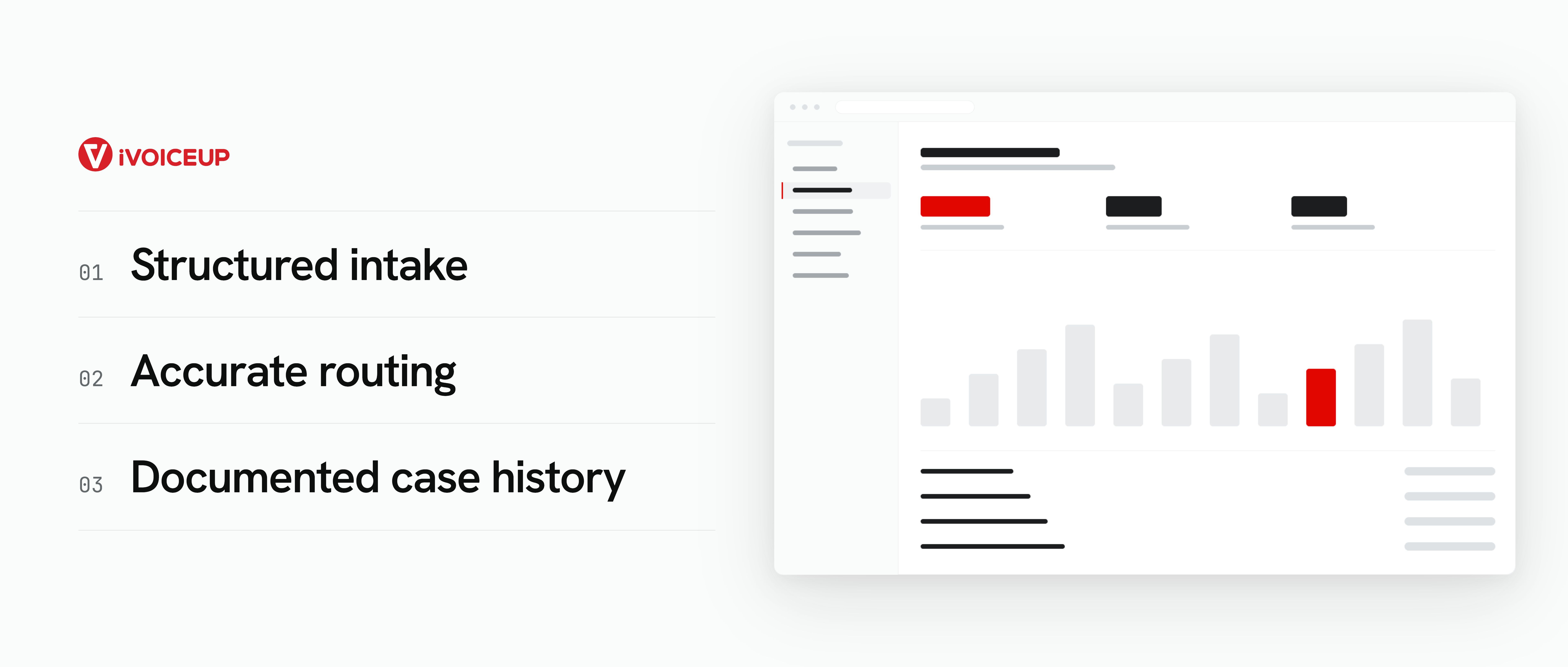
- Structured intake: Reports can be captured in a consistent format, giving compliance teams the information they need to assess the case.
- Accurate routing: Reports can be categorized and directed to the appropriate team or responsible person based on the nature of the concern.
- Documented case history: Each case can retain a record of ownership, actions, evidence, and resolution throughout the investigation, supporting structured case management .
These functions do not replace the bank’s regulatory obligations or internal policies. They provide the system through which a bank can manage reports consistently and maintain a clear record of how cases were handled.
For an Egyptian bank, that distinction is important. Law 194 provides part of the regulatory foundation, CBE instructions shape the wider governance and internal control framework, and the bank’s own policies determine how whistleblowing works in practice. The reporting system needs to support all three.
See how iVoiceUp supports whistleblowing programs for Egyptian banks. Request a demo.
Sources
Commercial International Bank, Whistleblowing Policy, March 2021. Housing and Development Bank, Governance disclosures, hdb-egy.com . Emirates NBD Group, Whistleblower Policy and Group Policy Repository. Central Bank of Egypt, Corporate Governance Instructions for Banks, August 2011, and Governance and Internal Control Instructions for Banks, September 19, 2024.
Disclaimer
This article is provided for general informational purposes and does not constitute legal advice. Named institutions and their policies are referenced from their own published materials. Organizations should confirm applicable obligations with qualified legal or compliance advisers.