By the iVoiceUp Compliance Team
Executive Summary
The UAE's approach to whistleblowing has undergone a fundamental shift between 2022 and 2026. What was once a fragmented, sector-by-sector patchwork of protections has become a structured, enforceable multi-framework reality, one that most organizations operating in the UAE now have to navigate actively rather than passively.
The Dubai International Financial Centre introduced its whistleblowing regime in 2022 . The Abu Dhabi Global Market followed with comprehensive regulations in 2024 , with a compliance deadline of 31 May 2025 that has now passed. Dubai's public sector gained formal whistleblower protections in May 2025. The UAE Central Bank operates its own reporting framework.
And with the Financial Action Task Force's mutual evaluation of the UAE scheduled for June 2026, enforcement scrutiny across all of these frameworks is actively increasing.
For compliance leaders, legal counsel, and senior management, the question is no longer whether to implement a whistleblowing framework, it is whether the one already in place is built to hold up under the regulatory environment that now exists.
The Numbers That Define the Obligation
The Regulatory Context: Why 2026 Matters
To understand the current urgency around whistleblowing compliance in the UAE, it helps to understand the broader trajectory.
In March 2022, the UAE was placed on the Financial Action Task Force's "grey list," a designation applied to countries with identified deficiencies in their anti-money laundering and counter-terrorism financing frameworks. The grey listing triggered increased international scrutiny and put significant pressure on the UAE to demonstrate meaningful reform across its financial crime and governance landscape.
The UAE was removed from the FATF grey list in February 2024, a result of sustained legislative and enforcement reform across multiple areas, including the introduction of new whistleblowing protections in both the DIFC and ADGM.
However, removal from the grey list is not the end of the process. The FATF's next mutual evaluation of the UAE is scheduled for June 2026, and it is anticipated that the evaluation will examine recent whistleblowing developments as further evidence of the country's commitment to tackling financial crime.
This means that 2026 is not a year for organizations to sit back. It is a year in which regulators across the UAE are expected to demonstrate the effectiveness of the frameworks they have put in place, and enforcement activity is expected to reflect that.
Four Years That Rebuilt the Framework
- March 2022, UAE placed on the FATF grey list: Identified deficiencies in anti-money laundering and counter-terrorism financing frameworks.
- April 2022, DIFC whistleblowing regime takes effect: Amendments to the DIFC Regulatory Law 2004 and the DFSA Rulebook.
- February 2024, UAE removed from the FATF grey list: Sustained reform, including the new whistleblowing protections in the DIFC and ADGM.
- 5 July 2024, ADGM Whistleblower Protection Regulations 2024: Introduced alongside amendments to the Employment Regulations 2019.
- 20 May 2025, Dubai Decision No. 2 of 2025: Formal whistleblower protections for Dubai's public sector, under the Financial Audit Authority.
- 31 May 2025, ADGM compliance deadline passes: Entities are now expected to be operating under the requirements, not preparing for them.
- June 2026, FATF mutual evaluation of the UAE: Anticipated to examine recent whistleblowing developments as evidence of reform.
The DIFC Framework
The Dubai International Financial Centre introduced its whistleblowing regime in April 2022 through amendments to the DIFC Regulatory Law 2004 and the DFSA Rulebook. The regime was the first of its kind in the UAE and applies to all DFSA-regulated entities operating in or from the DIFC.
What the law requires
The DIFC Operating Law provides that employees making good faith disclosures shall not, as a result of making the disclosure, be subject to any legal or contractual liability, be dismissed, or otherwise be subjected to any detriment by the employer.
Practically, this means DIFC-registered companies are required to:
- Protect employees who report wrongdoing from dismissal, demotion, or any form of workplace detriment.
- Maintain internal reporting channels that employees can use safely.
- Ensure that reporter identities are not exposed during the handling of a disclosure.
The cost of non-compliance
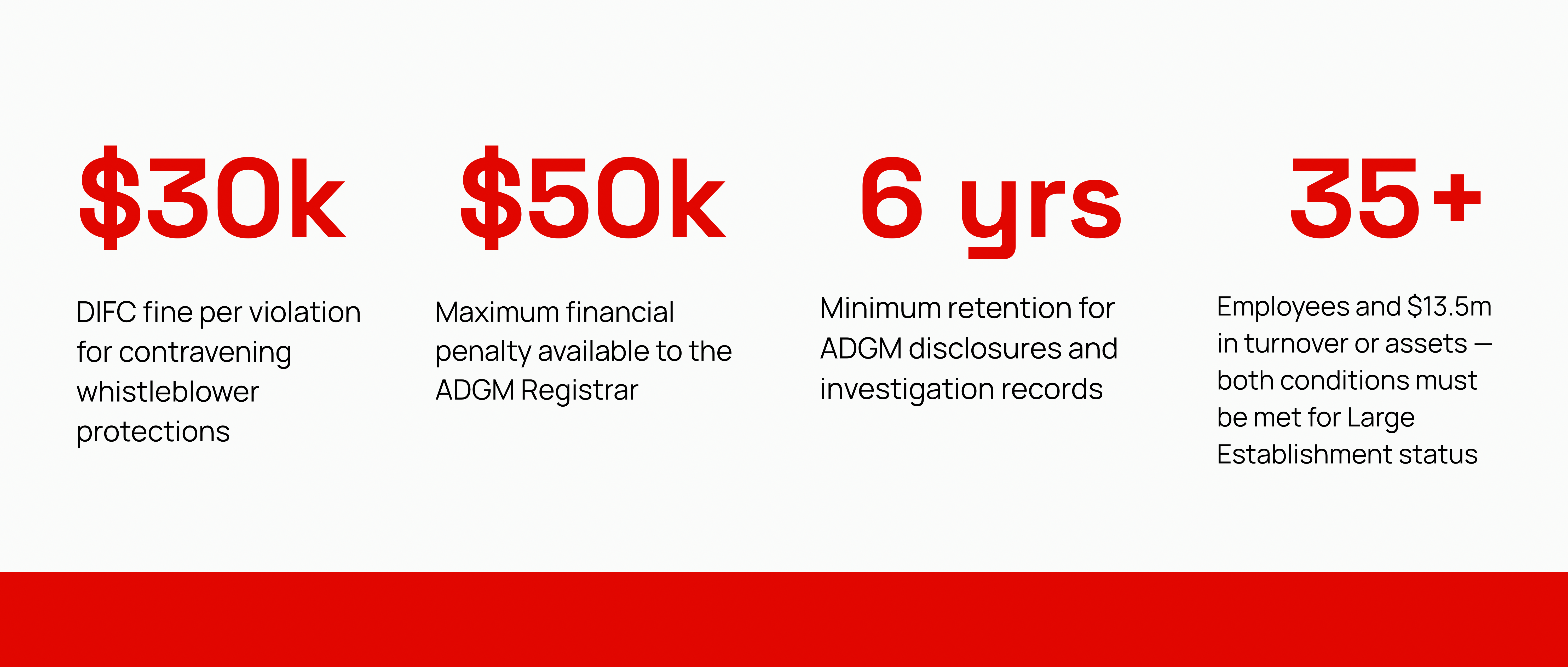
Any act in contravention of these provisions may result in a fine of USD 30,000. This fine applies per violation, meaning a single incident involving identity exposure and subsequent retaliation could trigger multiple penalties.
Beyond financial penalties, regulatory scrutiny in DIFC often focuses on governance culture. During inspections, DFSA examiners may assess whether internal reporting mechanisms are accessible, independent, and capable of producing complete audit trails. Financial penalties, public reprimands, or licence restrictions can follow governance failures.
Where organizations fall short
The most common gap is not the absence of a whistleblowing policy, it is the absence of a process that can actually protect reporter identity in practice. When reports are handled informally or routed through general HR channels, identity exposure becomes a matter of process design rather than intent. A name shared unnecessarily, a report routed to the wrong person, an email visible to the wrong team, any of these can constitute a breach under the DIFC framework regardless of whether retaliation was deliberate.
The ADGM Framework
The Abu Dhabi Global Market introduced its whistleblowing framework on 5 July 2024 through the Whistleblower Protection Regulations 2024 and amendments to the Employment Regulations 2019. The compliance deadline for ADGM entities was 31 May 2025.
Who it applies to
All ADGM-based entities with more than 35 employees and a turnover or assets under control of more than USD 13.5 million are classified as Large Establishments and required to comply with the regulations' written policy and record-keeping requirements. Smaller entities are not exempt from the spirit of the framework, all registered entities are expected to maintain arrangements proportionate to the size and complexity of their business.
What the law requires
By 31 May 2025, ADGM employers were required to implement and maintain arrangements to facilitate protected disclosures, assess and escalate any concerns arising from the disclosure, and protect the identity of the whistleblower. They must also periodically review these arrangements to ensure they remain appropriate.
Protected disclosures under the ADGM framework cover:
- Knowledge or reasonable suspicion of money laundering, fraud, or other financial crime.
- Knowledge or reasonable suspicion of a contravention of any law applicable in or to the ADGM.
Confidentiality is not treated as a theoretical principle under the ADGM framework. The regulations require practical safeguards capable of protecting identity and preventing unauthorized access. During supervisory engagement, regulators may examine how anonymity is preserved, how case access is restricted, and how records are stored.
Record retention
A key operational requirement under the ADGM regulations is record retention.
Disclosures and investigation records must be retained for a minimum of six years.
This creates a documentation obligation that extends well beyond the life of any individual case, and one that manual or informal processes are poorly equipped to meet.
Penalties
Where an employer retaliates or threatens to retaliate against an employee who intends to make or has made a protected disclosure, the employee may apply to the ADGM courts for a declaration to that effect, and the employer may be ordered to compensate the employee. Separately, the ADGM Registrar holds the power to issue censures, impose financial penalties of up to USD 50,000, or suspend or withdraw an entity's commercial licence for contraventions of the regulations.
How the ADGM and DIFC frameworks compare
Both frameworks offer broadly similar protections, confidentiality, anti-retaliation, and the right to make disclosures in good faith. The ADGM regime is broader in scope, covering any contravention of ADGM law alongside financial crime, and is supported by more comprehensive guidance. The DIFC framework was the first to be established and remains the more established of the two in terms of enforcement precedent. Organizations operating in both free zones need to ensure their whistleblowing arrangements satisfy the more demanding elements of each.
Beyond the Free Zones: The Broader UAE Landscape
While the DIFC and ADGM frameworks are the most developed and enforceable, the UAE whistleblowing landscape extends beyond the two financial free zones.
UAE Labour Law (Federal Decree-Law No. 33 of 2021)
Article 47 of the UAE Labour Law provides quasi-whistleblower protection by prohibiting the termination of an employee, or legal action against them, for filing a serious complaint with the Ministry of Human Resources and Emiratisation that is proven true, or a lawsuit against the employer that is proven valid. Where unlawful termination is established, courts may award compensation capped at three months' wage. This applies to onshore UAE employees and provides a baseline level of protection, though it is narrower in scope than the free zone frameworks and does not establish a formal internal reporting obligation on employers.
UAE Central Bank
The UAE Central Bank has implemented a whistleblowing framework enabling stakeholders to report issues related to fraud, conflicts of interest, and breaches of its code of conduct. The Central Bank offers an encrypted online portal for anonymous reporting and assures whistleblowers that they are protected from retaliation. This framework applies specifically to reports concerning CBUAE's own employees, contractors, and representatives, not to employees of the entities it supervises, but it signals the direction of regulatory expectations across the financial sector.
Dubai Resolution No. 2 of 2025
Issued on 20 May 2025 by Sheikh Maktoum bin Mohammed in his capacity as Chairman of the Financial Audit Authority, Decision No. 2 of 2025 ensures whistleblowers in Dubai's public sector can report wrongdoing or cooperate with the Financial Audit Authority without fear of retaliation. It also safeguards their employment and guarantees confidentiality throughout the investigation process. This decision applies to employees within entities overseen by the Financial Audit Authority and represents a meaningful step toward formal public sector whistleblower protections in Dubai.
Federal Tax Authority
The FTA operates an informant arrangement that allows individuals to confidentially report non-compliant business activities, with monetary rewards available in proportion to the tax collected as a result of the information provided. This is the closest the UAE comes to the US-style financial incentive model for whistleblowing.
Onshore UAE: The Remaining Gap
Onshore UAE remains without a single comprehensive whistleblowing law but operates through a patchwork of UAE Penal Code obligations (notably Article 323 on the positive obligation to report criminal conduct), UAE Labour Law unlawful termination protections, Federal Tax Authority informant arrangements, and sector-specific regimes. This gap is significant for organizations with large onshore workforces. Without a comprehensive federal framework, employees in onshore entities have fewer formal protections, and organizations have less regulatory clarity about what constitutes adequate internal reporting infrastructure.
The Multi-Framework Challenge
For most organizations of meaningful scale operating in the UAE, the relevant question is not which whistleblowing framework applies, it is how to manage obligations across multiple frameworks simultaneously.
A holding company with entities registered in both the DIFC and ADGM, employing staff across onshore Dubai and Abu Dhabi, faces overlapping obligations with different requirements around:
- What constitutes a protected disclosure in each jurisdiction.
- How reporter identity must be protected in each framework.
- How long records must be retained.
- What retaliation protections apply and under which enforcement body.
- How cases must be escalated and documented.
Organizations that implemented whistleblowing systems in response to one framework without considering their full jurisdictional exposure may find gaps emerging as enforcement activity increases ahead of the 2026 FATF evaluation.
What Good Compliance Looks Like in Practice
Across the DIFC and ADGM frameworks, and the broader UAE landscape, several consistent principles define what effective whistleblowing compliance looks like operationally.
Anonymous reporting that is genuinely anonymous
Both frameworks require that reporter identity be protected in practice, not just in policy. This means the system itself, not just the people operating it, must be designed to prevent identity exposure. Voice masking for verbal reports , restricted case access on a strict need-to-know basis, and automatic anonymization at intake are all features that regulators may examine during supervisory engagement.
Documentation from intake to resolution
Effective arrangements must include the ability to assess and escalate concerns from the moment of disclosure. This requires automatic timestamping of reports, a documented chain of custody for every case, and a complete record of investigation steps and outcomes. Manual processes, email threads, shared folders, unstructured notes, are unlikely to meet the evidentiary standard that ADGM's six-year retention requirement applies. AI is also changing what that evidence looks like, as recordings and documents become easier to fake. Read more on AI whistleblowing in the UAE .
Periodic review of arrangements
The ADGM regulations explicitly require that whistleblowing arrangements be periodically reviewed to ensure they remain appropriate. This is not a one-time compliance exercise, it is an ongoing operational obligation. Organizations should build review cycles into their compliance calendars and document the outcomes of each review.
Staff awareness
A lack of reports does not automatically mean that the business or culture is functioning without issue. Regulators are increasingly alert to organizations that present zero reports as a compliance success. Effective arrangements require that employees actually know the reporting channel exists, understand how to use it, and trust that it is genuinely anonymous. This means active communication, not just a policy document filed away somewhere.
Investigation independence
Where a report concerns senior management, the investigation must be capable of proceeding without that management's involvement. This requires either an independent internal function or an external channel that routes reports away from the people being reported about.
Conclusion
The UAE's whistleblowing compliance landscape in 2026 is more developed, more enforced, and more consequential than it has ever been. The DIFC regime is established and enforcement-backed. The ADGM deadline has passed and entities are now expected to be operating under its requirements. Public sector protections are expanding. And with the FATF evaluation scheduled for June 2026, regulators across the UAE have strong institutional reasons to demonstrate that the frameworks they have put in place are working in practice.
For organizations operating in this environment, the priority is not to implement a whistleblowing framework for the first time, most have done that. The priority is to examine whether what is in place is genuinely adequate: whether it protects identity in practice, whether it documents cases in a way that holds up under scrutiny, whether it covers the full jurisdictional footprint of the organization, and whether employees actually know it exists and trust it enough to use it.
The compliance bar in the UAE has moved. The organizations that recognize that now are the ones that will be prepared when it counts.
Readiness Self-Assessment
Each statement below restates a principle set out in this briefing. Any item you cannot answer with a confident yes is a gap worth documenting before a regulator asks about it.
01, Anonymity by design
- The system prevents identity exposure by design, not by the discretion of whoever handles the report.
- Anonymization happens automatically at intake.
- Case access is restricted on a strict need-to-know basis.
- Verbal reports can be made without voice identification.
- No report routes through a general HR inbox or a shared mailbox.
02, Documentation and Retention
- Every report is timestamped automatically on receipt.
- Each case carries a documented chain of custody.
- Investigation steps and outcomes are recorded in full, not in email threads or unstructured notes.
- Records are retained for at least six years, as ADGM requires.
- Concerns can be assessed and escalated from the moment of disclosure.
03, Jurisdictional Coverage
- Every entity in the group is mapped to the framework or frameworks that apply to it.
- Where DIFC and ADGM both apply, arrangements satisfy the more demanding elements of each.
- Onshore employees have a channel, despite the absence of a federal obligation.
- The arrangements were designed against full jurisdictional exposure, not one framework.
04, Review and Independence
- Review cycles sit in the compliance calendar, with outcomes documented.
- A report about senior management can be investigated without their involvement.
- An independent internal function or external channel routes reports away from the people named in them.
05, Awareness and Trust
- Employees know the channel exists and understand how to use it.
- They trust that it is genuinely anonymous.
- The channel is actively communicated, not filed away as a policy document.
- Zero reports is treated as a question to investigate, not a result to report.
See where your organization's whistleblowing arrangements stand before a regulator does. Book a demo with iVoiceUp .
Sources
● DFSA
● ADGM
● CBUAE
● UAE Government Portal ( u.ae )
● Dubai Media Office
● Herbert Smith Freehills Kramer
● Clyde & Co
● HFW
This briefing is provided for general information and does not constitute legal advice. Organizations should take advice on their specific circumstances and jurisdictional footprint.