By the iVoiceUp Compliance Team
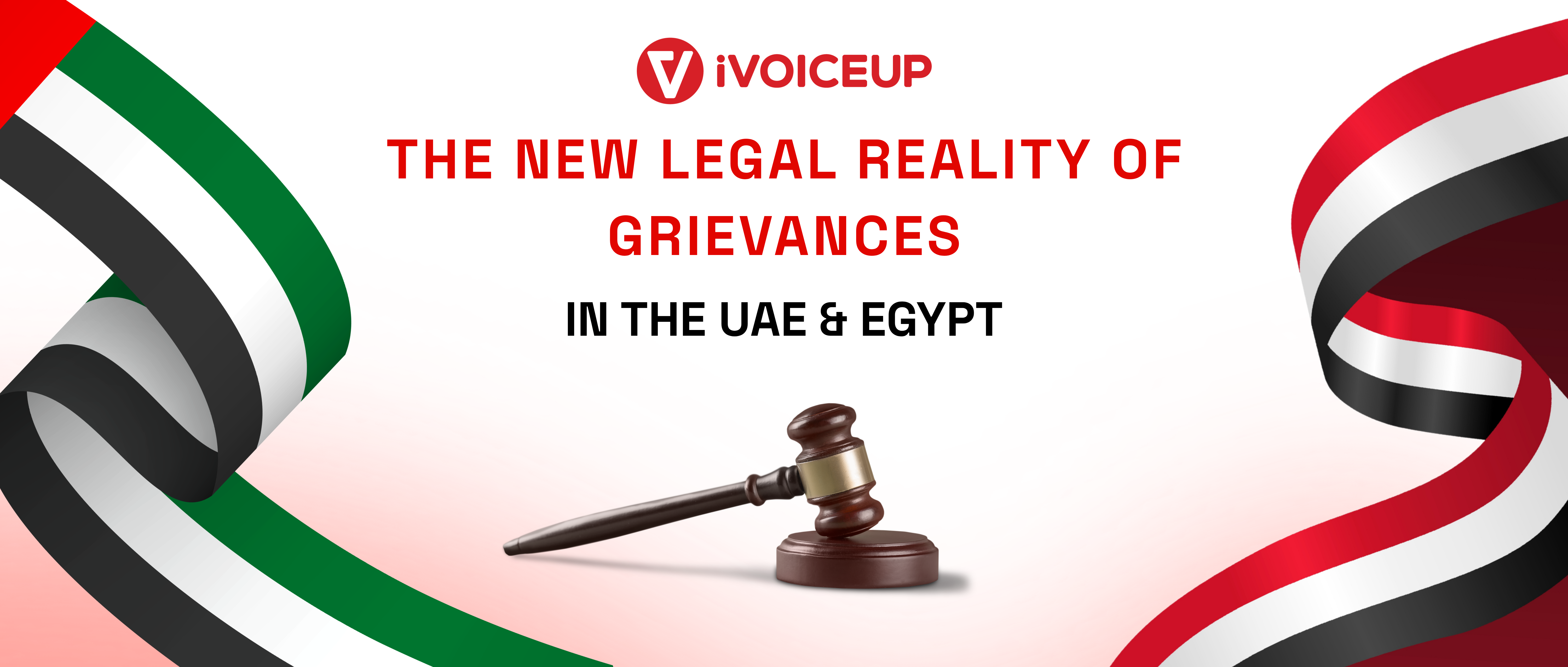
In both the UAE and Egypt, how a company handles an employee's grievance is no longer just a culture question, it is a legal one. Here is what changed in each market, and what it means for how organizations should document and manage concerns.
When an employee raises a concern at work , what happens next is not just a matter of company culture. In both the UAE and Egypt, it's a matter of law, and getting the process wrong carries real legal exposure.
In the UAE: documentation decides everything
Under Federal Decree-Law No. 33 of 2021 , the UAE's employee grievance procedure is designed to resolve disputes through mediation before they reach the courts. The Ministry of Human Resources and Emiratisation registered over 503,000 labour complaints through its official channels in 2025 alone, alongside 145,840 grievance requests, most related to salary disputes, end of service benefits, and termination.
The detail that catches most employers off guard is how much weight documentation carries. Cases are decided based on records, not verbal explanations, missing documentation weakens an employer's position before mediation even begins.
Before any disciplinary penalty can be imposed, employers must:
- Notify the worker in writing of the violation.
- Hear the worker's statement and review their defense.
- Document the case in the worker's file.
- Notify the worker in writing of the penalty, its type, extent, and reasons.
There's also a clock running. A worker cannot be accused of a violation more than 30 days after its discovery, and no penalty can be imposed more than 60 days after the investigation concludes. Miss that window, and the disciplinary action itself may not hold up.
In Egypt: the law moved the goalposts in 2025
Egypt's new Labour Law No. 14 of 2025 took effect on September 1, 2025, replacing the law that had governed employment relationships since 2003. One of its more consequential changes affects how disciplinary termination works:
- Termination as a disciplinary sanction can now only be ordered by the competent labour court.
- Employers may impose lesser disciplinary measures on their own authority.
- Dismissal itself is reserved for cases of gross misconduct and requires judicial approval.
The law is also explicit about what employers must prevent in the first place. Harassment, bullying, and any form of verbal, physical, or psychological violence against a worker is prohibited under the law, with internal work regulations expected to define the disciplinary response.
The Common Thread
Different legal systems, same underlying requirement: a documented, fair, and timely process for handling concerns before they escalate. Employees in both markets are entitled to raise concerns without fear of retaliation, and organizations that implement clear, accessible, and impartial mechanisms reduce legal risk while building genuine workplace trust.
Where this becomes difficult in practice is consistency. A concern raised informally to one manager and never documented is a concern that doesn't exist if it's ever challenged later. A structured internal reporting channel , one that timestamps every report, routes it appropriately, and keeps a record from first contact to resolution, is what turns a policy on paper into something that holds up under scrutiny.
iVoiceUp sits alongside the legal process by addressing exactly what both frameworks require. Every report submitted through the platform is automatically timestamped and stored, creating the documented record that UAE mediation bodies and Egyptian labour courts base their decisions on. Its case management system tracks each concern from submission through resolution, ensuring the investigation timeline is recorded and nothing exceeds the legally mandated windows. For compliance teams overseeing operations across both markets, the analytics layer surfaces patterns across reports, turning isolated incidents into visibility before they reach a formal dispute.
The legal bar in both the UAE and Egypt has moved. Organizations that build structured, documented reporting processes now are the ones that will be prepared when it counts, because they treat internal reporting as infrastructure, not as an afterthought.
UAE vs Egypt comparison table
| Aspect | UAE | Egypt |
|---|---|---|
| Governing law | Federal Decree-Law No. 33 of 2021 | Labour Law No. 14 of 2025 |
| In effect since | 2021 | September 1, 2025, replacing the 2003 law |
| Primary process | Employer investigation, then MOHRE mediation before courts | Employer may impose lesser measures; termination requires labour court approval |
| Disciplinary termination | Employer decision, subject to mediation and dispute rules | Requires a labour court ruling |